
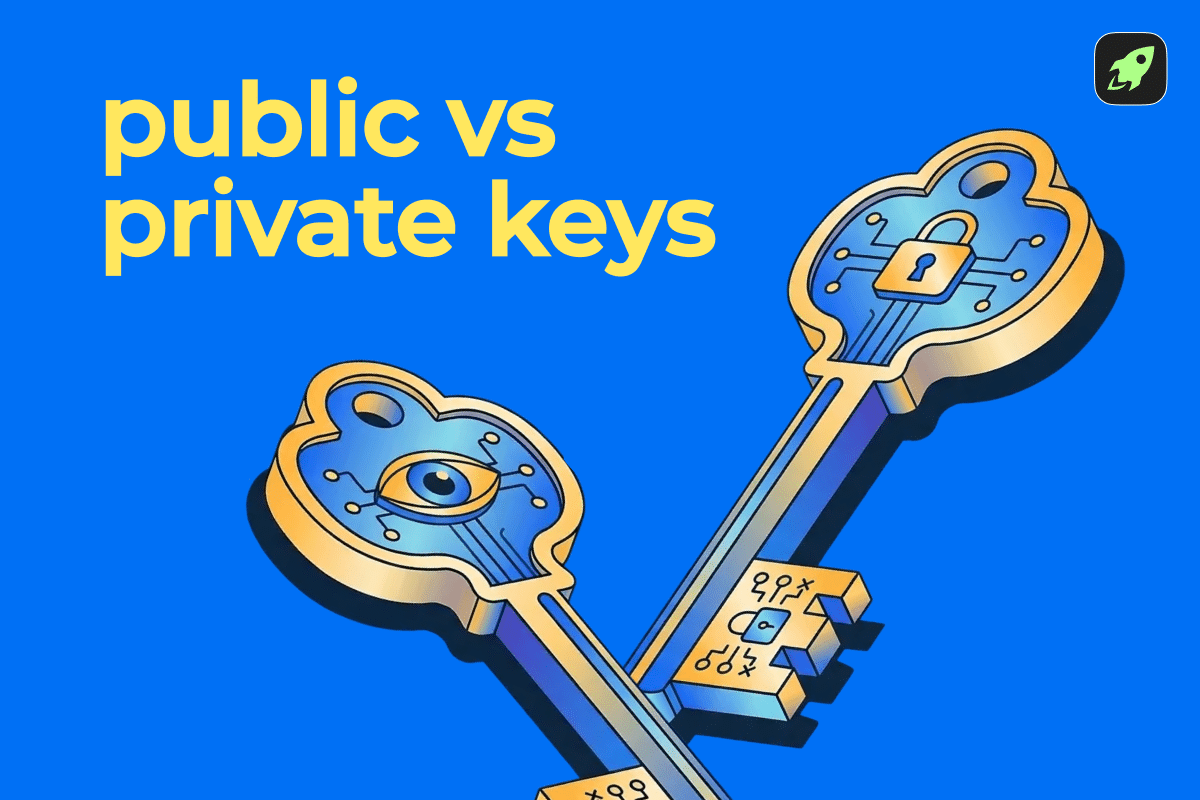
You can’t use a crypto wallet without cryptographic keys. In blockchain, public key cryptography runs the show. You have public and private keys. They work together, but they’re nothing alike. And understanding how public/private key encryption works is absolutely essential. Mess up your private key, and you lose access forever. Let’s break down public keys vs. private keys in blockchain, how they’re built, and why they’re the backbone of every crypto transaction.
What Is a Private Key and How Does It Work?
Your private key (or secret key) is the master password to your crypto. It’s a long, random string of letters and numbers used to unlock your crypto wallet, sign off on crypto transactions, and prove you own your funds. Without it, you’re locked out, with no recovery and no reset.
Here’s how it works: When you want to send crypto, you use your private key to create a digital signature. This signature proves the transaction is legit. The network checks that signature using your corresponding public key. If it checks out, the transaction goes through. If not, it’s rejected.
This system—known as public key cryptography—keeps your crypto secure even over a public channel like the internet. The public key is used to verify your identity, and your private key is used to keep your assets private.
If you lose your private key, you lose access to your funds. That’s the bottom line. This is why most people use a hardware wallet to store their cryptocurrency, or write down their seed phrase to back it up, just in case.
Find out more in our dedicated article: What Is a Private Key?
What Is a Public Key and How Does It Work?
A public key is your crypto wallet’s public face. It’s safe to share. In fact, you need to share it, because otherwise, no one can send you any crypto. Think of it like a bank account number. With it, people can send you money, but they can’t touch your funds.
When you create a wallet, the system generates a key pair: your private key, and your public key, which is mathematically derived from the private one. This process uses complex math, usually based on Elliptic Curve Cryptography (ECC). But here’s the important part: even though the public key comes from the private key, no one can reverse-engineer it. That’s what makes public key encryption so secure.
In practice, your public key is used to receive crypto and verify digital signatures. When someone sends you funds, they use your wallet address—a shortened, hashed version of your public key. When you send funds, your private key signs the transaction, and the network uses your corresponding public key to confirm that signature is real. We’ll break down the details of this process in the next section.
Learn more in our dedicated article: What Is a Public Key?
How to Get Free Crypto
Simple tricks to build a profitable portfolio at zero cost

How Public and Private Keys Work Together
Public and private keys are a team. One key locks, the other unlocks. Here’s the flow: Your private key creates a digital signature when you send a transaction. This signature proves it’s really you without revealing your key to anyone. Then, the network uses your public key to verify it with math.
This is the magic of asymmetric encryption. You can share your public key freely. You can even shout it out across the internet. But your private key? That must stay with you, always.
Let’s use an example: Say Alice wants to send Bob some bitcoin. She asks for his public address (aka wallet address), which is a shortened version of his public key. She sends the funds. Bob uses his private key to unlock them and prove ownership. The blockchain confirms the match using Bob’s public key.
This system keeps crypto transactions secure without needing passwords, accounts, or a middleman. Just public and private keys working together. One signs. The other verifies. And only the intended recipient can access the funds.

What Is the Main Difference Between Public and Private Keys?
It comes down to privacy: public keys are for sharing, private keys are for keeping secret.
You give out your public key so people can send you crypto, like a bank account number. You don’t risk anything by sharing it. Your private key is more like the vault code to all your assets. It’s used to sign transactions and prove ownership of your crypto, and you shouldn’t ever share it with anyone.
The important part is that they’re a matched set. Your public key can only be signed by your corresponding private key, making sure only you can access the crypto people send you. That’s the core of public key cryptography, and what keeps your crypto secure without revealing anything.
Just remember: Lose your private key, and you also lose access to your funds. There’s no password reset in blockchain.
All Differences Between Public and Private Keys
Public and private keys do different jobs, but they work as one. To really understand how cryptocurrency transactions stay secure, you need to break down the differences. From visibility to creation to risk, here’s how these two cryptographic keys stack up.
Visibility
A public key is meant to be seen. It can be freely shared with anyone—friends, exchanges, even the whole internet. It’s how people find you on the blockchain. Your wallet address, used to receive crypto, is created by hashing this key.
A private key, on the other hand, is top secret. You never share it. Anyone who gains access to your private key has complete access to your crypto wallet and funds. It’s the decryption key for your entire wallet. If someone steals it, they can take everything—and there’s no way to get it back.
Purpose
Your public key is used to receive cryptocurrency transactions and verify that a transaction is authentic. It confirms that a transaction really came from the person it claims to. The blockchain network uses it to verify signatures without ever needing to see your private key.
At the same time, your private key is used to sign transactions, which proves that you control the funds linked to your wallet. It acts like a digital fingerprint, creating a digital signature unique to each transaction. Without it, you can’t move funds or interact with smart contracts. It’s your proof of ownership.
Function in Blockchain
Your public key links directly to your blockchain address. When someone sends you crypto, it’s your public key that lets them do it. The blockchain uses that key to track where funds should go and to confirm the identity behind a signature.
Meanwhile, your private key is what lets you control that address. It allows you to access your funds, sign off on transactions, and prove that the money is actually yours. Without it, you’re locked out. That’s why only the intended recipient—you—should ever have it.
How It’s Created
A public key is generated from a private key using a one-way mathematical function. That means it’s easy to go from private to public, but impossible to go backward. This is part of how asymmetric encryption keeps the blockchain secure.
Private key generation happens first, and it’s usually a long random number created using cryptographic software. Wallets often give you a seed phrase that can recreate your private key if you lose it. Everything starts with this key, so it’s critical to protect it from the start.
Read more: What Is a Seed Phrase in Crypto?
Reversibility
A public key is mathematically tied to its corresponding private key, but it can’t be used to reverse-engineer the private key from the public one. That’s why it’s safe to share. Public key encryption is built on “trapdoor functions”—math that’s easy one way, but impossible the other.
A private key, on the other hand, holds all the power. It creates your public keys, signs transactions, and unlocks access to your funds. If someone has your private key, they don’t need anything else. They have total control of your wallet and can use any of your public addresses.
Security Risk
A public key has little to no security risk. Anyone can see it, and you can post it anywhere online without worrying. It’s not enough to access or control your wallet. It’s just an identifier, used by the network to confirm your actions.
A private key, however, carries huge risk. If someone gets it, they’re now in total control of your crypto. That’s why you use a hardware wallet (or any kind of cold wallet) and seed phrase to protect it. Private key encryption works as the only gatekeeper between your funds and the outside world.
Used For
Your public key is used to receive funds and check the validity of incoming transactions. It also verifies any signatures made with the matching private key. It’s what lets the blockchain trust without ever meeting you.
Meanwhile, your private key is used to sign transactions, prove ownership, and decrypt messages tied to your wallet. It’s also what you need to recover your account using your seed phrase. Without this key, nothing happens, and no one can help you.
Comparison Table: Public vs. Private Keys
Still not clear on the split between public and private keys? Here’s a side-by-side cheat sheet so you can see the difference at a glance.
| Difference | Public Keys | Private Keys |
| Visibility | Shared openly and safe to publish | Kept secret and must never be shared |
| Main Use | Receive crypto, verify signatures | Sign transactions, access wallet |
| Control | No control over funds | Full control of funds |
| Creation | Derived from the private key using one-way math | Randomly generated during wallet setup (or from a seed phrase) |
| Reversibility | Cannot be reversed to find private key | Can generate the public key |
| Security Risk | Low: Exposure doesn’t compromise wallet | High: If leaked, wallet is compromised |
| Used For | Generating public addresses, checking identities | Proving ownership, creating digital signatures |
| Storage | Stored on-chain or shared via apps and services | Stored offline (hardware wallet, seed phrase, cold wallet) |
Final Thoughts
Public and private keys aren’t just tech jargon, but the core of how the blockchain stays secure. Your public key is how people find you. Your private key is how you stay in control of what you have.
If there’s one golden rule in crypto, it’s this: protect your private key, because all your crypto savings depend on it. Use a hardware wallet, back up your seed phrase, and never share it.
This system is what makes cryptocurrency transactions possible without banks, passwords, or middlemen. But it also puts all the responsibility into your hands.
So learn the difference between your private and public keys, and keep your crypto yours.
Disclaimer: Please note that the contents of this article are not financial or investing advice. The information provided in this article is the author’s opinion only and should not be considered as offering trading or investing recommendations. We do not make any warranties about the completeness, reliability and accuracy of this information. The cryptocurrency market suffers from high volatility and occasional arbitrary movements. Any investor, trader, or regular crypto users should research multiple viewpoints and be familiar with all local regulations before committing to an investment.