
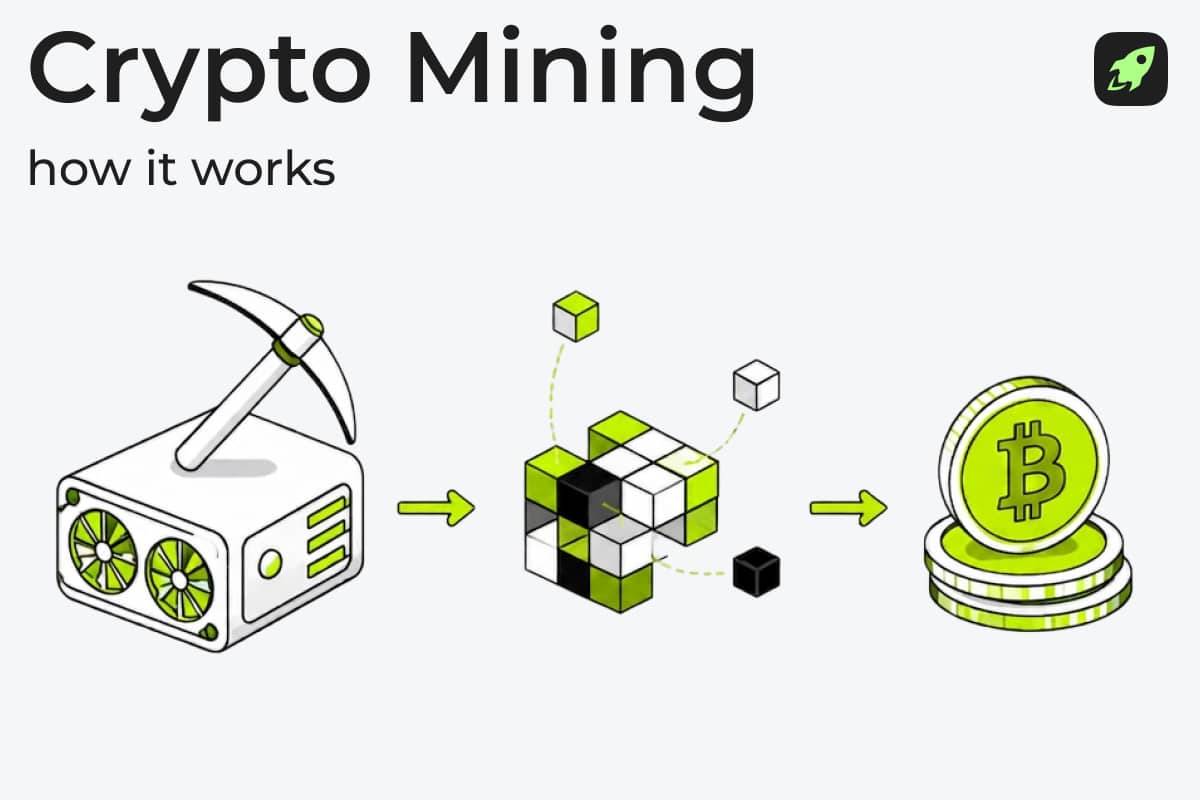
Crypto mining can sound straightforward until terms like hash rate, nonces, mempools, difficulty, and ASICs start piling up. Then there are the practical questions: who actually confirms transactions, why does mining consume so much electricity, and can you still earn money doing it?
This guide breaks the process down without reducing it to the misleading idea that miners simply “solve puzzles” to create coins.
What Is Crypto Mining?
Cryptocurrency mining is the competitive process through which participants on a proof-of-work blockchain use computing power for the chance to publish the next valid block. Mining hardware repeatedly hashes block-header data until it finds an output that meets the network’s target. The successful miner can claim a block reward consisting of newly issued coins—the block subsidy—plus transaction fees.
Crypto mining does more than create new coins. It helps order transactions, update the shared ledger, and make past records costly to alter. Full nodes independently verify every proposed block before accepting it, so miners propose transaction history rather than unilaterally approving it. Bitcoin mining is the best-known example, but other proof-of-work networks use related processes with different algorithms and rules.
Why Do Cryptocurrencies Need Mining?
Proof-of-work networks need a way for independent participants to agree on transaction history without placing one company, bank, or server in control. Mining supports that system in several connected ways.
Maintaining a Shared Ledger Without a Central Operator
Miners compete to propose blocks, while full nodes independently enforce the network’s consensus rules. Anyone can verify the chain, and no single miner can make an invalid block acceptable simply by spending more electricity.
Ordering and Confirming Transactions
New transactions propagate across the network and enter the mempools maintained by individual nodes. Miners select transactions, usually prioritizing those that offer higher fees relative to their size, and assemble them into candidate blocks.
Once a valid block is accepted, its transactions receive one confirmation. Each later block adds another confirmation, making a reversal progressively more difficult. Bitcoin targets an average block interval of about ten minutes, though individual blocks can arrive sooner or later.
Preventing Double Spending
Double spending occurs when someone attempts to use the same funds in conflicting transactions. Full nodes reject blocks containing invalid spends, while proof-of-work makes replacing already confirmed history increasingly expensive. The combination gives users greater confidence as more blocks accumulate after a transaction.
Making Transaction History Expensive to Rewrite
Each Bitcoin block includes the previous block’s hash, linking the chain together. Changing an older transaction would change its block and require an attacker to redo the proof-of-work for that block and every block after it, then overtake the honest chain.
This protection is economic rather than absolute. A network with more honest hash rate generally costs more to attack, but difficulty alone doesn’t make invalid transactions valid—full nodes still enforce the protocol’s rules.
Incentivizing Participants With Mining Rewards
Mining hardware, cooling, maintenance, and electricity all cost money. The protocol compensates successful miners through:
- Block subsidy: Newly issued cryptocurrency created under the network’s monetary rules
- Transaction fees: Payments attached to transactions included in the block
Bitcoin reduces its subsidy every 210,000 blocks, or roughly every four years. That schedule is specific to Bitcoin and shouldn’t be generalized to every mineable cryptocurrency.
Mining vs. Minting vs. Staking
Mining, minting, and staking all relate to block production or asset issuance, but they aren’t interchangeable.
| Process | Main Resource | Typical Participant | How Blocks Are Proposed |
|---|---|---|---|
| Mining | Computing power and electricity | Miner | Searches for a qualifying proof-of-work hash |
| Staking | Locked cryptocurrency | Validator | Is selected under a proof-of-stake protocol |
| Minting | Depends on the protocol | Issuer, validator, or smart contract | Creates new tokens or assets under defined rules |
Bitcoin mining uses proof-of-work. Proof-of-stake, used by Ethereum, replaces the computational race with validators who lock ETH and participate under the network’s staking rules. Ethereum completed the Merge on September 15, 2022, ending proof-of-work mining on Ethereum Mainnet.
“Minting” is broader. It may refer to creating new tokens, issuing an NFT, or producing blocks on some proof-of-stake or proof-of-authority networks. Unlike mining, it doesn’t necessarily involve competitive hashing.
How Does Crypto Mining Work? A Step-by-Step Example
The exact implementation differs by network, but the following example shows how Bitcoin-style proof-of-work mining moves a transaction from broadcast to confirmation.
Step 1: A Transaction Is Broadcast to the Network
A user signs a transaction and sends it to peers. Nodes check its basic validity before relaying it to other participants.
Step 2: The Transaction Enters a Node’s Mempool
Each node maintains its own mempool of valid, unconfirmed transactions. Mempools can differ because nodes may receive transactions at different times or apply different local policies.
Step 3: A Miner Selects Transactions
A solo miner or mining pool chooses transactions for a candidate block. Fee rate usually affects priority, but miners can apply their own selection policies within the protocol’s rules.
Step 4: The Miner Constructs a Candidate Block
The miner creates a coinbase transaction that claims the potential reward, adds selected transactions, and prepares the data needed for the block header. At this stage, the block is only a proposal.
Step 5: A Merkle Root Commits to the Block’s Transactions
Transaction identifiers are hashed into a Merkle tree. Its final value—the Merkle root—is placed in the block header, cryptographically committing the header to the block’s transaction set.
Step 6: Mining Software Creates the Block Header
The header includes the previous block’s hash, the Merkle root, a timestamp, the encoded target, a version field, and a nonce. Mining software sends work to the mining hardware and updates adjustable data when needed.
Step 7: Hardware Changes the Nonce and Calculates Hashes
Bitcoin mining hardware applies SHA-256 twice to the block header, changes the nonce or other adjustable data, and tries again. Hash rate measures how many attempts the equipment can perform per second.
Step 8: A Hash Must Meet the Target Threshold
A block is eligible only when its hash is numerically equal to or below the network target. Because hash outputs are unpredictable, miners can’t calculate the winning nonce directly—they must keep guessing.
Step 9: The Successful Miner Broadcasts the Proposed Block
When a miner finds a qualifying hash, it combines the header with the full block and broadcasts the proposal to the network.
Step 10: Full Nodes Validate or Reject the Block
Full nodes verify the proof-of-work, transaction validity, reward amount, block structure, and other consensus rules. A block that breaks those rules is rejected regardless of the miner’s hash rate.
Step 11: The Accepted Block Joins the Blockchain
Valid nodes add the block to their local chain and relay it. If two valid blocks appear at nearly the same time, competing branches may briefly exist. The network eventually converges on the branch with the most accumulated work, and the other valid block becomes stale.
Hashes, Nonces, Targets, and Difficulty Explained
These four concepts describe the core mining search:
- Block hash: A fixed-length output derived from the block header. In Bitcoin, miners apply double SHA-256.
- Nonce: A header field miners vary while searching for a qualifying hash. Modern miners also change other data when the nonce range is exhausted.
- Target threshold: The highest numerical hash that counts as valid. A lower target leaves fewer qualifying outputs.
- Mining difficulty: A relative measure of how hard it is to find a valid hash compared with a reference target.
Bitcoin adjusts difficulty every 2,016 blocks based on how long the previous period took. The goal is to keep the long-term average block interval near ten minutes as total network hash rate changes.
Why Valid Proof-of-Work Is Difficult to Find but Easy to Verify
Proof-of-work relies on an important asymmetry. Finding a qualifying hash may require an enormous number of attempts because each result is effectively unpredictable. Verifying the result requires a node to hash the submitted header and compare the output with the target.
That difference lets miners demonstrate costly work without forcing every node to repeat it. Nodes can quickly reject a fake or insufficient hash, then continue checking the block’s transactions and other consensus requirements.
What Are Hash Rate and Block Time?
Hash rate measures hash attempts per second. It can describe one machine, a miner, a pool, or an entire network. A larger share of total hash rate increases a miner’s probability of finding blocks over time, but it never guarantees a result within a specific period.
Block time is the observed interval between blocks, while the target block interval is the protocol’s intended long-term average. Bitcoin aims for about ten minutes. Because mining is probabilistic, one block may take seconds and another may take far longer.
Miners vs. Full Nodes vs. Mining Pools
These roles overlap in some operations, but they perform different functions.
| Participant | Primary Role | Requires Mining Hardware? | Earns Mining Rewards? |
|---|---|---|---|
| Miner | Searches for qualifying proof-of-work hashes | Yes | Yes, directly or through a pool |
| Full node | Validates blocks and transactions and enforces consensus rules | No | No |
| Mining pool | Coordinates miners and distributes payouts | Pool participants do | Yes, then distributes them |
A mining pool aggregates work from many miners. Participants submit lower-difficulty “shares” that demonstrate contributed work. When the pool finds a network-valid block, it distributes the payout under its chosen reward method.
Pooling reduces payout variance, but it also introduces fees, operator reliance, and payout-policy risk. It doesn’t increase the total expected reward produced by a given amount of hash rate before fees.
How to Get Free Crypto
Simple tricks to build a profitable portfolio at zero cost

Can a Miner Operate Without Running a Full Node?
Yes, many individual miners connect to a pool, and the pool provides block templates and communicates with the Bitcoin network. The miner’s equipment focuses on hashing rather than maintaining and validating the entire blockchain.
Running your own full node gives you independent verification and reduces reliance on a pool’s view of the chain. It doesn’t directly increase your hash rate or chance of finding a block, but it gives you more control over transaction and block validation.
How Crypto-Mining Rewards Work
A successful Bitcoin miner claims the allowed block reward through the block’s coinbase transaction. The total has two components.
Block Subsidy: Newly Issued Cryptocurrency
The block subsidy creates new coins under the protocol’s issuance schedule. Bitcoin’s subsidy halves every 210,000 blocks and is expected to decline toward zero over time.
Transaction Fees: Payments From Network Users
A Bitcoin transaction fee is the difference between the transaction’s total inputs and outputs. The miner that includes the transaction can claim that fee as part of the block reward.
Fees vary with demand for block space. When many users compete for confirmation, higher-fee transactions are generally more attractive to miners.
Coinbase Transaction: How a Reward Is Claimed
The coinbase transaction is the first transaction in a Bitcoin block. Unlike an ordinary transaction, it doesn’t spend a previous output. It creates the permitted subsidy and assigns the block’s fees to an address chosen by the miner or pool.
Newly mined Bitcoin from a coinbase transaction can’t be spent until it reaches the protocol’s required maturity period.
Why Miners Prioritize Some Transactions Over Others
Bitcoin miners usually compare fees with transaction size rather than looking only at the absolute fee. A smaller transaction paying the same total fee as a larger one offers a higher fee rate and may be selected first.
Miners aren’t required to include every transaction. They may also exclude transactions for technical, policy, or operational reasons as long as the resulting block remains valid.
Solo Mining vs. Pool Mining
Solo mining and pool mining use the same underlying proof-of-work process, but they distribute risk differently.
- Solo mining: You keep the full reward if you find a block, but payouts can be extremely rare and unpredictable.
- Pool mining: You contribute hash rate to a group and receive smaller, more regular payouts based on the pool’s accounting system.
Bitcoin’s developer documentation distinguishes solo mining’s high payout variance from pooled mining’s lower variance. For most small miners, pool participation offers more predictable cash flow, though fees and counterparty risks reduce the appeal.
What Equipment Does Crypto Mining Use?
The right equipment depends on the network’s mining algorithm, current difficulty, electricity costs, and the efficiency of available hardware.
CPU Mining
CPU mining uses a general-purpose computer processor. It worked during Bitcoin’s earliest years but can’t compete with modern SHA-256 ASICs. CPUs remain relevant only on certain networks designed to resist specialized hardware or favor general-purpose computation.
GPU Mining
GPU mining uses graphics cards that can perform many calculations in parallel. GPUs remain useful on some proof-of-work networks and can switch between compatible algorithms, making them more flexible than ASICs.
FPGA Mining
Field-programmable gate arrays can be configured for specific workloads. They may offer better efficiency than GPUs while retaining more flexibility than ASICs, but their complexity and limited ecosystem keep FPGA mining relatively niche.
Mining Software and Supporting Infrastructure
Mining software connects hardware to a solo node or pool, receives work, builds or updates headers, and submits results. A practical setup may also require:
- Power supplies and electrical upgrades
- Cooling and ventilation
- Network connectivity
- Monitoring and remote-management tools
- Noise and heat controls
Why Bitcoin Mining Is Dominated by SHA-256 ASICs
Bitcoin uses SHA-256, and specialized Application-Specific Integrated Circuits are engineered to perform that workload at extremely high speed and efficiency. General-purpose CPUs and GPUs devote chip space and power to features Bitcoin mining doesn’t need, so they produce far fewer hashes per watt.
As ASIC capacity expanded, Bitcoin’s difficulty adjusted upward to reflect the added network hash rate. Modern Bitcoin mining is therefore dominated by specialized equipment and large operations with access to power, cooling, repairs, and capital.
Is Crypto Mining Profitable?
Mining profitability depends on both revenue and total cost. A realistic calculation should include:
- Expected block rewards and fees
- Coin price and price volatility
- Network difficulty and your share of hash rate
- Hardware price, efficiency, and useful life
- Electricity, cooling, maintenance, and downtime
- Pool fees and payout terms
- Taxes and local compliance costs
A halving doesn’t automatically make mining unprofitable, and a rising coin price doesn’t guarantee profit. Efficient equipment and low-cost electricity can improve your position, but returns remain exposed to market conditions and competition. Treat profitability calculators as estimates rather than promises.
How Mining Helps Secure a Blockchain
Mining makes some attacks expensive by requiring real-world resources. To replace confirmed Bitcoin history, an attacker would need to build an alternative chain with enough accumulated work to overtake the honest chain. The required cost generally grows as more blocks are added.
However, hash power can’t override every rule. Full nodes reject blocks that create too many coins, spend nonexistent funds, or otherwise violate consensus. Proof-of-work helps determine which valid history the network follows, while node validation determines whether a proposed block is valid at all.
Crypto Mining’s Energy and Environmental Impact
Proof-of-work mining consumes electricity because specialized hardware runs continuously while searching for hashes. Bitcoin’s exact footprint changes with network hash rate, equipment efficiency, mining location, and the electricity mix used by operators.
Environmental impact can’t be reduced to one global number. Emissions differ between facilities powered by low-carbon electricity and those dependent on fossil fuels. Mining can also create local concerns involving grid demand, noise, electronic waste, water use, and heat.
When evaluating energy claims, check the study period, methodology, and whether the source distinguishes electricity consumption from greenhouse-gas emissions. The Cambridge Digital Mining Industry Report provides industry-wide estimates while documenting the limits and assumptions behind them.
Can You Mine Cryptocurrency at Home?
You can mine some cryptocurrencies at home, but Bitcoin mining is usually impractical for an average household. SHA-256 ASICs are expensive, loud, hot, and power-intensive, while residential electricity often costs more than industrial contracts.
Before buying equipment, check:
- Your all-in electricity price
- Circuit capacity and ventilation
- Hardware efficiency and expected lifespan
- Pool fees and minimum payouts
- Local rules, taxes, lease terms, and noise limits
- Whether expected revenue covers both operating and hardware costs
GPU mining may be more accessible on certain networks, but it still carries price, difficulty, and hardware risks. For many users, home mining works better as a technical hobby than as dependable income.
What Is Cloud Mining?
Cloud mining lets you buy or rent mining capacity from a provider instead of owning the equipment. The provider operates the hardware and credits payouts under the contract’s terms.
This arrangement removes the need to handle heat, noise, and maintenance, but it adds counterparty risk. Fees, contract duration, difficulty changes, downtime rules, and withdrawal conditions can make an apparently attractive offer unprofitable. Fraudulent schemes may also advertise guaranteed mining returns, so avoid any provider that can’t clearly explain its equipment, costs, ownership, and payout model.
What Is Cryptojacking?
Cryptojacking is the unauthorized use of another person’s computer, phone, server, or cloud resources to mine cryptocurrency. It may arrive through malware, compromised credentials, malicious scripts, or vulnerable software.
The unauthorized workload can slow systems, increase electricity or cloud bills, and create extra heat. Keep software updated, use reputable endpoint protection, secure cloud credentials, and investigate unexplained CPU usage or cost spikes.
Final Thoughts
Crypto mining combines block production, economic incentives, and network security. Miners search for valid proof-of-work, pools coordinate participants, and full nodes decide whether proposed blocks follow the rules. Whether you’re considering a home setup or simply trying to understand Bitcoin, focus on the full picture—hardware, electricity, difficulty, fees, validation, and risk. Mining can support a decentralized network, but it’s never automatic or guaranteed income.
FAQ
Is crypto mining legal?
Crypto-mining laws vary by jurisdiction and may involve energy, tax, licensing, zoning, or equipment restrictions. Check current national and local rules before buying hardware or signing a hosting contract.
Can Bitcoin be mined with a laptop or phone?
Not competitively. Modern Bitcoin mining uses specialized SHA-256 ASICs, so a laptop or phone produces negligible hash rate while adding heat, power use, and hardware wear.
Can Ethereum still be mined?
No, Ethereum Mainnet switched from proof-of-work to proof-of-stake on September 15, 2022, so ETH mining ended.
How long does it take to mine one Bitcoin?
There’s no fixed time because miners find blocks probabilistically and receive a block reward rather than exactly one BTC. Your expected payout depends on hash rate, difficulty, pool terms, and the current subsidy and fees.
What is the difference between hash rate and difficulty?
Hash rate measures how many hashing attempts occur per second. Difficulty expresses how hard the network makes it to find a qualifying hash and adjusts over time to support the target block interval.
Why do miners join mining pools?
Pools combine hash rate and distribute payouts based on contributed work, giving miners smaller but more frequent earnings. The tradeoffs include fees, payout rules, and reliance on the pool operator.
What happens when Bitcoin’s subsidy reaches zero?
Bitcoin’s subsidy is expected to reach zero around 2140. Miners would then rely on transaction fees, while the network would continue adjusting difficulty based on available hash rate.
Can mining damage computer hardware?
Sustained heat, dust, poor ventilation, and unstable power can shorten hardware life. Proper cooling, conservative operating settings, and maintenance reduce the risk but don’t eliminate wear.
Why does crypto mining use so much electricity?
Proof-of-work rewards miners for performing competitive hash calculations, so large networks operate substantial amounts of hardware continuously. Total consumption depends on hash rate and equipment efficiency.
Disclaimer: Please note that the contents of this article are not financial or investing advice. The information provided in this article is the author’s opinion only and should not be considered as offering trading or investing recommendations. We do not make any warranties about the completeness, reliability and accuracy of this information. The cryptocurrency market suffers from high volatility and occasional arbitrary movements. Any investor, trader, or regular crypto users should research multiple viewpoints and be familiar with all local regulations before committing to an investment.