
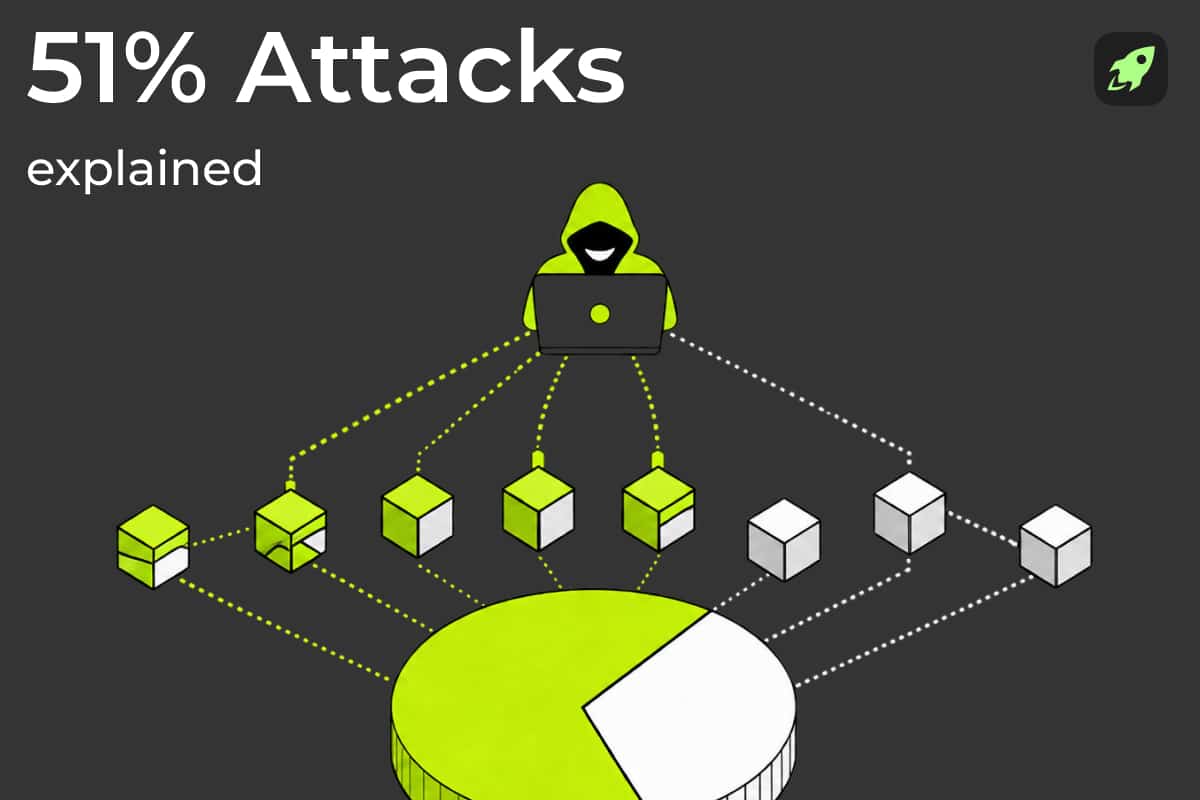
Imagine one entity quietly taking over more than half of a blockchain network’s mining power, then rewriting recent transaction history to their advantage. That’s a crypto 51% attack in a nutshell. It’s not a theoretical exploit buried in whitepapers. Smaller blockchain networks have already lived through it, and the damage—double spending, chain reorganizations, collapsed confidence—can hit within a few hours.
What Is a 51% Attack in Crypto?
A 51% attack happens when a single entity, or a coordinated group, gains majority control over (meaning it controls more than half of) whatever power a blockchain network’s consensus mechanism uses to validate blocks. In proof-of-work systems like the Bitcoin network, that power is hashing power, and the attacker takes control of the network’s mining power—its hashrate. With more than half of the network’s mining power, they can manipulate transactions by influencing which chain becomes the canonical chain.
Blockchain networks follow fork-choice rules, which typically prefer the longest chain (the chain with the most accumulated proof of work). That means the attacker doesn’t need to “hack” nodes—they just outmine honest miners and other miners in block production. This risk is highest on smaller networks, where mining power is more concentrated and easier to rent.
Why Does a 51% Attack Matter?
A 51% attack can undermine confidence by showing the potential risks of majority control on a live blockchain. In such an attack, an attacker can reverse transactions, trigger chain reorganizations, and extract value before the network catches up.
The most common impact is double spending: The attacker pays on the public chain, then releases a private fork that removes that payment and lets them spend the same coins again. Such attacks can also censor transactions by excluding them from blocks, which disrupts users and damages the network’s reliability.
Even when the protocol stays secure at the cryptographic level, a 51% attack still creates operational risk. Exchanges may raise confirmation requirements, pause deposits, or delist an asset after such attacks because the market often treats rewritten history as a fundamental failure.
How Is a 51% Attack Usually Implemented?
A 51% attack works by controlling fork choice: the network accepts the longest chain (or heaviest chain), so the attacker builds an alternative history and then forces a chain reorganization when their chain wins.
1. Majority Hashrate or Validator Control
The attacker first gains majority control. In proof-of-work, that means controlling most of the network’s hashing power, so a single entity holds more than half of its mining power. In proof-of-stake, control shifts to staked tokens: on Ethereum, around 51% of staked ETH can bias fork choice for future blocks, while rewriting finalized history typically requires more than 66% validator weight.
2. Private Chain Creation
Next, the attacker starts a new chain in private. A single miner can produce new blocks that reference previous block information from historical blocks while honest miners and all the other miners keep extending the public chain. If the attacker has enough computing power, their private blocks eventually catch up and overtake the public chain.
3. Public Transaction Broadcast
The attacker then sends transactions on the main network as usual—for example, depositing to an exchange on the Bitcoin blockchain—while continuing to mine privately. During this phase, the attacker can manipulate transactions by including them on the public chain but excluding them from the private chain. With enough control, they later force the network to accept the attacker’s version.
4. Longer or Heavier Chain Release
Once the private fork becomes the longest chain, the attacker releases the new chain. Nodes compare proof-of-work and switch to the stronger chain, creating an altered blockchain history without breaking cryptography. Hashing power and computing power make the difference here: the attacker wins because they can produce more proof, faster.
5. Chain Reorganization (Reorg)
After release, chain reorganizations happen automatically as nodes adopt the longest chain. The displaced blocks become orphan blocks, even if users previously treated them as confirmed. How many blocks get replaced determines the damage: Deeper blocks require more time and resources to rewrite, so most attacks focus on shallow history where reorgs remain feasible.
6. Reversed or Excluded Transactions
Finally, the attacker uses the reorg to reverse transactions or exclude them. In a successful attack, attackers can execute double spending by removing a payment from history and reclaiming the same coins. They can also manipulate transactions through selective inclusion, which turns ordinary settlement delays into an exploit window.
What Can an Attacker Do During a 51% Attack?
With majority control, attackers can impose their version of history on the network for a limited time. Here’s what that looks like in practice:
- Double spending. The attacker spends the same coins on the public chain, then reverses those transactions with a reorg and spends the same coins again. This is the primary goal in most successful attacks.
- Transaction censorship. The attacker can selectively exclude specific transactions from blocks, preventing them from confirming for as long as their majority control holds.
- Transaction ordering manipulation. With control over which transactions enter new blocks, the attacker can reorder them to their advantage—front-running payments or delaying competitors’ transactions.
- Temporary network disruption. If the attacker fills blocks with empty or low-value transactions, legitimate activity stalls. This can resemble a denial of service against honest miners and users alike.
- Exchange and merchant losses. Credits that appeared settled disappear after a reorganization. Exchanges and merchants that accepted deposits before the chain was sufficiently confirmed are left with no valid record while the attacker retains the value.
How to Get Free Crypto
Simple tricks to build a profitable portfolio at zero cost

What Can’t an Attacker Do in a 51% Attack?
Even with majority control, a 51% attack has some limits. Here’s what attackers cannot do:
- No theft without private keys. Attackers can’t steal coins from wallets they don’t control. Private keys still secure funds, and nothing about majority hashing power changes that.
- No valid signature forgery. Every transaction must carry a valid cryptographic signature. Attackers can’t forge these, so they can’t authorize spends on someone else’s behalf.
- No arbitrary coin creation. A 51% attack doesn’t let attackers mint coins beyond the protocol’s issuance rules. Block rewards and supply schedules remain enforced by every node on the network.
- Limited historical rewrites. Deep rewrites across historical blocks are impractical. Reverting 30 blocks, for example, requires producing at least 30 consecutive replacement blocks while outpacing the honest chain the entire time.
- No automatic protocol takeover. Majority control only influences which chain the network accepts. It doesn’t grant the attacker the power to change protocol rules, alter consensus parameters, or override the broader node network.
Why Is Double Spending the Main 51% Attack Example?
Double spending is the most common 51% attack crypto example because it targets services that credit deposits quickly. Attackers deposit on the Bitcoin blockchain, wait a few hours for shallow confirmations, then release a private fork that causes chain reorganizations. That rewrite can reverse transactions, leaving the service with no valid deposit record while the attacker keeps the same coins.
This pattern shows why a successful attack usually focuses on timing and confirmation depth, not wallet hacking. Attackers exploit fork-choice rules, then profit from the gap between “seen on the network” and “securely settled.” On smaller networks, that gap can be big enough to make double spending viable.
How Do Confirmations Reduce 51% Attack Risk?
Confirmations reduce 51% attack risk by shrinking the attacker’s window. Each time new blocks land on top of a transaction, a reorg must replace how many blocks came after it, plus the block that contains it. To do that, the attacker must outpace the honest chain by producing more new blocks, which usually requires controlling network hashrate and hashing power beyond everyone else combined.
In practice, the Bitcoin network makes this hard because of high costs, but smaller chains can be easier targets. Monitoring can also help detect sudden hashrate shifts, long chain reorganizations, or unusual orphan blocks over a few hours. Still, confirmations remain the simplest control: they make transactions more secure by raising the cost of rewriting history.
Why Are Smaller Proof-of-Work Blockchains More Vulnerable?
Smaller networks and smaller blockchains tend to have lower network hashrate, so renting hashing power or redirecting mining power can be enough to launch a 51% attack. That reduces the theoretical cost compared to larger networks, where high costs and sustained hardware commitments make majority control harder to maintain. Put simply, the same attack economics that fail on the Bitcoin network can work on a smaller chain.
Because security budgets are lower, attackers can buy or rent computing power, overwhelm honest miners, and trigger reorgs before services respond. The Bitcoin blockchain still provides the clearest reference for how proof-of-work resolves forks, but the cost to exploit that mechanism varies widely by network size. That’s why risk rises as security falls.
How Are 51% Attacks Different in Proof-of-Work and Proof-of-Stake?
A 51% attack targets the consensus mechanism, but the resource differs. Proof-of-work relies on hashing power and mining power to produce proof, while proof-of-stake relies on staked tokens and validator weight. In both cases, majority control over the network can bias fork choice and increase reorg risk.
| Proof-of-Work (PoW) | Proof-of-Stake (PoS) | |
| Control resource | Hashing power / mining power | Staked tokens / validator stake |
| Attack threshold | More than 50% of network hashrate | More than 50% of active validator stake (fork choice). Over 66% to attack finality on Ethereum |
| How power is acquired | Own or rent mining hardware and energy | Accumulate or borrow staked tokens |
| Typical impact | Chain reorganizations, double spending, transaction censorship | Fork-choice manipulation, transaction censorship, finality attacks at higher thresholds |
| Built-in penalty for attackers | None beyond wasted hardware and energy costs | Slashing: malicious validators can lose staked funds and be ejected |
| Last-resort recovery | Community-coordinated hard fork to a new chain | Social coordination / minority soft fork. Ethereum docs describe this as a recovery path |
| Real-world examples | Ethereum Classic (2019, 2020), Bitcoin Gold (2018–2020) | No major confirmed incidents to date on large PoS networks |
What Real-World 51% Attacks Have Happened?
51% attacks have repeatedly hit smaller proof-of-work chains. Two well-known examples involve Ethereum Classic and Bitcoin Gold, where such attacks led to chain reorganizations and double spending, especially when attackers could gain majority control for a few hours.
Ethereum Classic Incidents
Ethereum Classic saw more than one 51% attack, including incidents in January 2019 and August 2020. In such attacks, attackers exploited low network hashrate on the ETC chain, triggered deep chain reorganizations, and reversed history by replacing blocks. Double spending followed because exchanges credited deposits before the new history became final. These incidents affected multiple blockchain networks and reinforced how quickly confidence can drop when a chain’s history becomes unstable.
Bitcoin Gold Incident
Bitcoin Gold is another high-profile case. The Bitcoin Gold chain experienced repeated reorganizations consistent with a 51% attack pattern, where attackers gained majority control through hashing power and executed double spending. A successful attack typically targeted services that credited deposits quickly, creating exchange and merchant losses after the reorg replaced blocks. As with other such attacks, the core issue wasn’t broken cryptography—it was the economics of overwhelming mining power on a smaller chain.
How Can Networks and Services Defend Against 51% Attacks?
Defenses focus on making a 51% attack expensive and easier to detect. Services can raise confirmation requirements and adjust them dynamically when potential risks rise, especially on chains with volatile network hashrate. They can also monitor nodes and network data for chain reorganizations, unusual orphan rates, and sudden shifts in hashing power or mining power.
At the network level, decentralizing mining power helps by keeping block rewards distributed across more honest miners, which makes majority control harder to assemble. Some ecosystems also coordinate through community incident response during emergencies, though that adds complexity and can create trade-offs. The goal is to keep the network secure by raising the attacker’s cost and reducing the payoff window for double spending.
Final Thoughts
A 51% attack remains one of the most dangerous potential risks in crypto: Majority control over hashing power or validator stake can enable double spending, trigger chain reorganizations, and erode trust in blockchain networks overnight. Smaller proof-of-work chains are the most exposed, but no consensus mechanism is immune.
More confirmations, decentralized mining power, and active monitoring are the most practical defenses available today.
Disclaimer: Please note that the contents of this article are not financial or investing advice. The information provided in this article is the author’s opinion only and should not be considered as offering trading or investing recommendations. We do not make any warranties about the completeness, reliability and accuracy of this information. The cryptocurrency market suffers from high volatility and occasional arbitrary movements. Any investor, trader, or regular crypto users should research multiple viewpoints and be familiar with all local regulations before committing to an investment.