
You send a crypto payment, see it appear in the network, and assume the money has changed hands. But until the network settles that transaction, a conflicting payment could still take its place. This double-spending risk is one of the central problems any digital money system must solve—and it explains why Bitcoin and other blockchains need validation, consensus, and confirmations. In this article, we explore everything you need to know about double spending.
What Is Double Spending in Crypto?
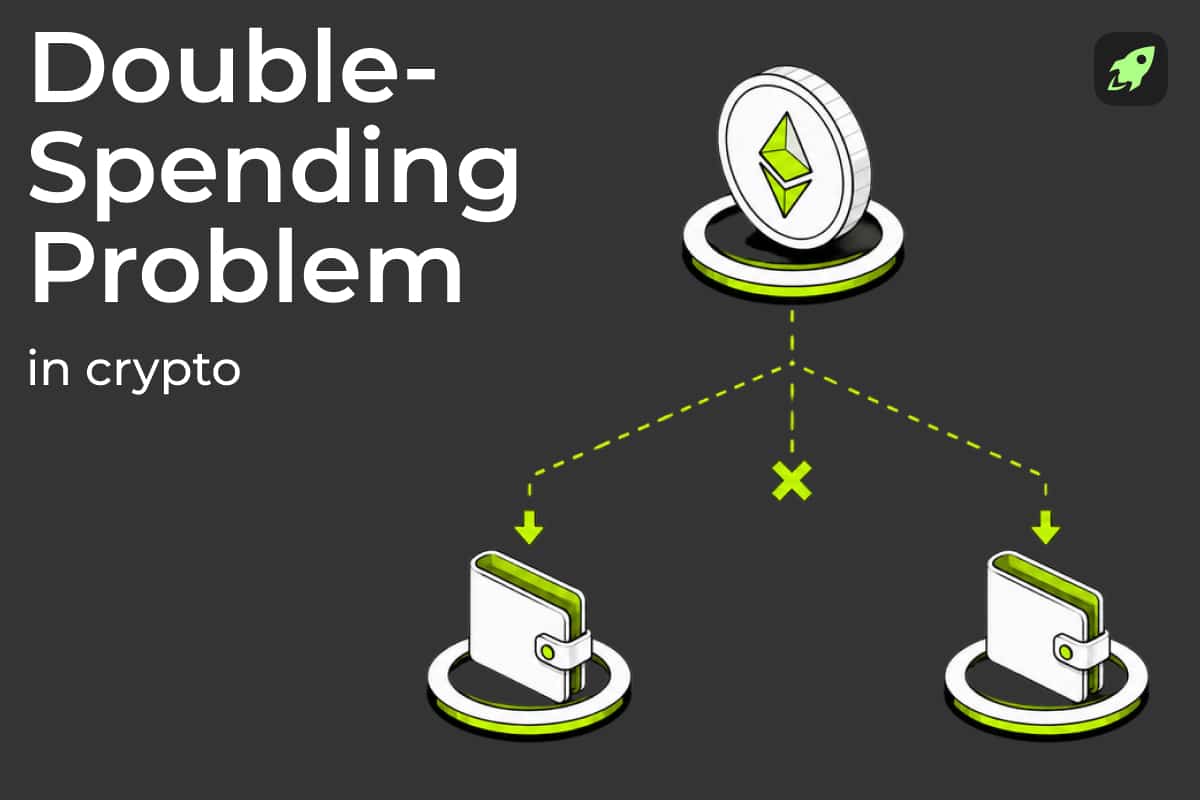
Double spending is the attempt to use the same cryptocurrency funds in two conflicting transactions. If one payment is accepted and the other later replaces it in the blockchain’s official history, the double spend succeeds.
The problem isn’t that someone can copy a cryptocurrency file. Crypto assets don’t exist as individual files stored on your device. Double spending is fundamentally a problem of transaction ordering and shared ledger state. A digital payment system needs an authoritative way to determine which funds remain spendable and which of two conflicting transactions should be accepted.
Satoshi Nakamoto addressed the double-spending problem in the Bitcoin white paper by proposing a peer-to-peer network that could agree on one transaction history without relying on a trusted central authority. Bitcoin combines digital signatures, transaction validation, the UTXO set, proof-of-work, and a shared fork-choice rule to ensure that only one conflicting payment survives in the accepted blockchain.
How Does a Double-Spend Attempt Work?
A double-spend attempt generally involves two transactions that try to use the same funds:
- The sender broadcasts a payment to a recipient.
- The sender creates a conflicting transaction that sends the same funds somewhere else.
- Different nodes may temporarily receive the transactions in different orders.
- Miners or validators include one of the transactions in the accepted chain.
- The other transaction becomes invalid relative to that blockchain history.
Both transactions may briefly circulate through the peer-to-peer network or appear in different nodes’ mempools. A mempool is only a node’s temporary collection of pending transactions, so seeing a payment there doesn’t guarantee that it will be confirmed.
A successful double spend occurs when a recipient delivers goods, services, or another asset based on one payment, but the blockchain ultimately accepts the conflicting transaction instead. That’s why cryptocurrency security depends on more than broadcasting a transaction—settlement matters, too.
Why Digital Signatures Alone Cannot Prevent Double Spending
A digital signature proves that the holder of a private key authorized a specific transaction and that its signed data hasn’t been altered. However, it doesn’t prove that the referenced funds are still available.
Someone who controls a private key can sign two transactions spending the same input. Both signatures may be cryptographically valid because both transactions were genuinely authorized by the key holder.
Preventing double spending therefore requires additional checks. Full nodes must verify that:
- The signature is valid.
- The transaction follows the protocol’s rules.
- The referenced funds exist.
- The funds haven’t already been spent.
- The transaction uses the correct sequence or nonce where applicable.
Digital signatures establish authorization. Transaction validation and consensus determine whether an authorized payment can become part of the accepted ledger.
How Do Blockchains Prevent Double Spending?
Blockchains don’t prevent double spending merely because transactions are public or cryptographically hashed. Protection comes from several mechanisms working together.
Transaction Validation by Full Nodes
Full nodes independently verify every transaction they receive. In a UTXO-based system, a node checks whether each referenced output remains in its current UTXO set. In an account-based system, it checks the sender’s balance, transaction nonce, and other state-transition rules.
A transaction that tries to reuse an already-spent input or execute with an invalid nonce is rejected. Bitcoin nodes can also identify a duplicate input spend when a transaction conflicts with one they’ve already received.
Because nodes perform these checks independently, you don’t need to trust a single server to maintain the spending record.
Blocks, Hashes, and the Shared Transaction History
Transactions are grouped into blocks, and each block references the previous block through a cryptographic hash. This structure creates an ordered, timestamped ledger that full nodes can independently validate.
The blockchain provides Bitcoin’s public transaction record, but hashing alone doesn’t make history impossible to change. Replacing a confirmed transaction requires replacing the relevant block and building an accepted competing chain from that point.
The deeper a transaction sits in the chain, the more difficult that replacement generally becomes.
Consensus Mechanisms and Fork-Choice Rules
Nodes may occasionally see competing blocks or branches. A consensus protocol gives them common rules for deciding which valid history to follow.
A complete consensus system includes more than proof-of-work or proof-of-stake. It also needs validation rules and a fork-choice mechanism that selects the canonical chain when several valid branches exist.
Bitcoin’s nodes compare cumulative proof-of-work. Ethereum’s fork-choice algorithm uses the accumulated weight of validator attestations. Once the network converges on one branch, transactions that conflict with its accepted state are excluded.
How Different Crypto Ledgers Track Spent Funds
Not every cryptocurrency represents funds in the same way. Bitcoin uses individual unspent outputs, while Ethereum maintains account balances and transaction sequence numbers.
| Ledger model | How funds are tracked | Main double-spend check |
|---|---|---|
| UTXO model | Separate unspent transaction outputs | The referenced output must remain unspent |
| Account model | Account balances and shared state | The account must have enough funds and use a valid nonce |
Bitcoin’s UTXO Set
Bitcoin represents spendable value as unspent transaction outputs, or UTXOs. Each transaction input references an output created by an earlier transaction.
Every full node maintains a UTXO set derived from the blockchain. When validating a new transaction, the node checks whether each referenced output is still present. Once an output has been consumed by a transaction in the accepted chain, it can’t be spent again in that same history.
Two transactions that reference the same UTXO conflict. They may both circulate temporarily, but they can’t both remain valid within one canonical blockchain.
Account Balances and Transaction Nonces
Ethereum and other account-based blockchains maintain balances as part of their global state. Each externally owned Ethereum account also has a nonce that increases as its transactions execute.
The sequential nonce provides replay protection and determines transaction order. Two transactions from the same account may use the same nonce, but only one can execute in the canonical chain. Once that nonce has been consumed, the conflicting transaction is no longer valid for inclusion.
Nonces aren’t the only protection. Ethereum clients also verify balances, signatures, gas requirements, and the validity of every resulting state transition.
Proof-of-Work vs. Proof-of-Stake
Proof-of-work and proof-of-stake help decentralized networks agree on one history, but they secure that history through different resources, incentives, and finality mechanisms.
| Feature | Proof-of-Work | Proof-of-Stake |
|---|---|---|
| Security resource | Computing power | Staked assets |
| Block participants | Miners | Validators |
| Chain selection | Cumulative proof-of-work | Stake-weighted validator votes |
| Typical finality | Probabilistic | Economic and checkpoint-based |
| Main attack cost | Hash rate and energy | Acquiring and risking stake |
Proof-of-Work: Miners, Chainwork, and Confirmations
In a proof-of-work blockchain, miners compete to produce valid blocks using computational power. Nodes normally follow the valid chain with the greatest cumulative proof-of-work.
Reversing a transaction requires an attacker to create a competing branch and catch up with or overtake the accepted chain. Each additional block built above the transaction increases the amount of work the attacker must replace.
This produces probabilistic finality. A transaction becomes progressively harder to reverse as confirmations accumulate, but no finite number of confirmations makes reversal mathematically impossible.
Proof-of-Stake: Validators, Stake, and Slashing
In a proof-of-stake network, validators commit crypto assets as collateral and vote on blocks. Ethereum combines its LMD-GHOST fork-choice rule with Casper FFG, a finality mechanism. Together, these components use validator votes to select and finalize the canonical chain.
Validators can lose funds and be removed from the network if they sign certain conflicting messages. This process, called slashing, penalizes dishonest proposals and attestations.
Slashing discourages conflicting votes, but it isn’t the only mechanism that creates finality. Ethereum finalizes checkpoint blocks after they receive votes representing at least two-thirds of the active stake.
Probabilistic Finality and Economic Finality
Probabilistic finality means the likelihood of reversal decreases as more blocks build on top of a transaction. It’s most closely associated with proof-of-work chains such as Bitcoin.
Economic finality means reversing a finalized block would require a major consensus failure and the destruction of substantial staked value. On Ethereum, a transaction reaches finality when it belongs to a checkpoint that can’t be reverted without large amounts of ETH being burned.
Neither model makes every newly broadcast transaction instantly final. You still need to distinguish between a pending transaction, an included transaction, and one that has reached an appropriate level of finality.
How to Get Free Crypto
Simple tricks to build a profitable portfolio at zero cost

Common Types of Double-Spending Attacks
Double spending can involve simple timing tricks or a deliberate attempt to replace part of the blockchain’s accepted history.
Zero-Confirmation and Race Attacks
A zero-confirmation attack targets a recipient who accepts a payment before it enters a block. In a race attack, the sender broadcasts two conflicting transactions to different parts of the network and hopes the preferred version reaches miners or validators first.
This attack doesn’t require majority control of the network. It exploits the period when a payment is still pending and different nodes may have received different transactions.
Finney Attacks
A Finney attack requires a proof-of-work miner. The miner privately creates a block containing a transaction that returns certain funds to the miner, then spends those same funds in an unconfirmed payment to a merchant.
After receiving the goods, the miner releases the private block. If the network accepts it, the merchant’s conflicting payment becomes invalid.
The attack depends on precise timing, mining participation, and a recipient willing to accept an unconfirmed transaction.
Chain-Reorganization Attacks
A chain reorganization, or reorg, occurs when nodes replace recent canonical blocks with blocks from a competing branch.
Reorganizations can happen naturally when miners or validators briefly produce competing blocks. They become a double-spending attack when someone deliberately builds an alternative history that removes a payment and includes a conflicting transaction.
Chain-reorganization attacks aren’t exclusive to proof-of-work. Proof-of-stake networks can also experience forks and reorganizations, although their voting, finality, and penalty systems change the attack conditions.
Majority or 51% Attacks
In a proof-of-work majority attack, an entity controls enough hash rate to outpace the honest network consistently. This power can make it easier to censor transactions, build competing branches, and reverse some recent payments.
However, a 51% attack doesn’t give the attacker unlimited control. Consensus power alone doesn’t let someone:
- Spend coins without the owners’ private keys
- Create unlimited coins under unchanged validation rules
- Make invalid transactions acceptable to honest nodes
- Rewrite arbitrarily old history without significant work
Double-spend attempts also don’t always require 51% of the hash rate. An attacker with less than half of the network’s power still has a nonzero chance of reversing a finite number of confirmations, although that probability falls as the honest chain grows.
Confirmations, Finality, and Double-Spend Risk
A confirmation shows that a transaction has entered a block. Each subsequent block adds another confirmation and generally reduces the probability that the transaction will be removed.
An Unconfirmed Transaction Isn’t Settled
An unconfirmed transaction is a proposed payment waiting in one or more mempools. It isn’t automatically fraudulent, and it isn’t itself a double spend.
However, it can still be replaced, rejected, or lose to a conflicting transaction. Different nodes maintain their own mempools, and receiving a transaction doesn’t guarantee that a miner or validator will include it.
You should therefore treat a zero-confirmation payment as pending rather than settled.
More Confirmations Reduce Risk
In proof-of-work systems, every additional confirmation increases the amount of cumulative work an attacker would need to replace.
The reduction in risk isn’t a universal fixed percentage. It depends on factors such as:
- The attacker’s share of the network’s hash rate
- The number of confirmations
- Network propagation and mining conditions
- The transaction’s value
- The recipient’s risk tolerance
A small retail payment and a multimillion-dollar exchange deposit don’t need the same settlement policy.
Six Confirmations Aren’t a Universal Rule
Six confirmations is a traditional Bitcoin heuristic, not a rule for every payment or blockchain. Bitcoin’s payment-processing guide describes the threshold as somewhat arbitrary and recommends it particularly for high-value or fraud-sensitive transactions.
The appropriate threshold depends on the network, transaction value, threat model, and available finality guarantees. Some recipients may accept fewer confirmations for low-value payments, while exchanges may require more during unusual network conditions.
Double Spending in Practice
The practical consequences of double spending depend on when the recipient treats a payment as complete.
Small Merchant Payment Example
Imagine a coffee shop that accepts Bitcoin as soon as a transaction appears in its wallet. The customer broadcasts the payment, receives the coffee, and sends a conflicting transaction using the same UTXO.
If the conflicting transaction enters the canonical chain first, the shop’s payment disappears from the spendable ledger. The merchant loses both the product and the expected funds.
Waiting for a suitable confirmation—or using a payment system designed to manage zero-confirmation risk—reduces that exposure.
Cryptocurrency Exchange Deposit Example
An exchange may detect an incoming deposit within seconds, but it typically won’t make the full balance available for withdrawal immediately.
Instead, the exchange waits for a network-specific number of confirmations or finalized checkpoints. This protects it from a user who deposits crypto, trades or withdraws another asset, and then causes the original deposit to disappear through a chain reorganization.
Because the potential loss is higher, exchanges generally apply stricter confirmation policies than small merchants.
How Users and Businesses Reduce Double-Spend Exposure
You can’t remove every form of settlement risk, but you can make a successful double spend much less likely:
- Don’t treat a mempool transaction as automatically final.
- Match the required confirmation depth to the payment’s value.
- Use finalized checkpoints when the blockchain provides them.
- Increase confirmation requirements during reorganizations or network instability.
- Run a full node or use reliable infrastructure to validate payments independently.
- Monitor for conflicting transactions instead of relying only on wallet notifications.
- Avoid applying Bitcoin’s six-confirmation heuristic to every cryptocurrency.
Businesses should define confirmation policies in advance rather than making an improvised decision after a payment arrives. The policy should account for the blockchain’s ledger model, consensus mechanism, finality rules, transaction size, and potential cost of reversal.
Final Thoughts
Double spending is the risk that one set of funds appears in two conflicting payments, but only one survives in the accepted ledger. Blockchains manage that risk through transaction validation, shared state, consensus, fork-choice rules, and finality. You don’t need to analyze every node and block before accepting crypto, but you should know the difference between a transaction appearing, being confirmed, and becoming appropriately settled.
FAQ
Can Bitcoin be double-spent?
A Bitcoin UTXO can’t be spent twice within the same accepted blockchain. However, a conflicting payment can replace an unconfirmed transaction, or a confirmed payment can theoretically disappear during a chain reorganization.
Is an unconfirmed transaction a double spend?
No, an unconfirmed transaction is simply pending, but it carries greater double-spend risk because a conflicting transaction could still be confirmed instead.
Can double spending happen without a 51% attack?
Yes, race attacks and Finney attacks target unconfirmed payments and don’t require majority hash-rate control.
Is double spending the same as counterfeiting?
No, counterfeiting creates unauthorized or fake money, while double spending attempts to reuse valid funds in incompatible transactions.
How does Ethereum prevent double spending?
Ethereum checks account balances and transaction nonces so conflicting transactions can’t both execute in the canonical state. Its proof-of-stake consensus, fork-choice rule, checkpoint voting, and slashing system also protect the accepted transaction history.
What is the difference between a fork and a chain reorganization?
A fork is a split into competing blockchain branches. A chain reorganization happens when a node changes which branch it considers canonical and replaces some of its previously accepted blocks.
Disclaimer: Please note that the contents of this article are not financial or investing advice. The information provided in this article is the author’s opinion only and should not be considered as offering trading or investing recommendations. We do not make any warranties about the completeness, reliability and accuracy of this information. The cryptocurrency market suffers from high volatility and occasional arbitrary movements. Any investor, trader, or regular crypto users should research multiple viewpoints and be familiar with all local regulations before committing to an investment.