
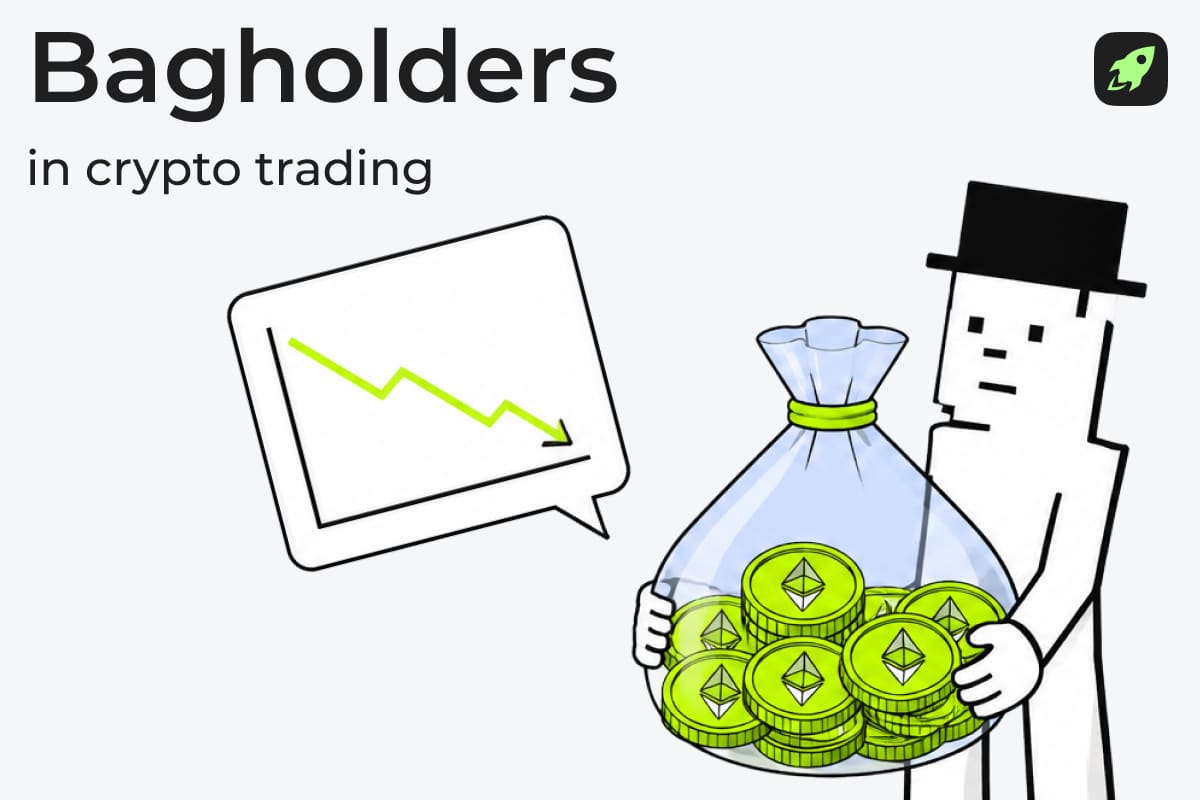
You bought in because everyone sounded convinced. Then the chart turned red, the hype disappeared, and selling suddenly felt harder than holding. That’s where the crypto slang term bagholder can hit worryingly close to home—it describes the uncomfortable moment when a “temporary dip” starts looking like a losing position you don’t know how to exit.
What Is a Bagholder in Crypto?
So, what is a bagholder in crypto? In crypto slang, a “bag” is a position in a coin or token—often an altcoin—that has dropped so far that you’re sitting on unrealized losses. When that declining asset looks unlikely to recover and you still won’t exit, people may call you a bagholder.
The term wasn’t invented by crypto. It comes from the phrase “left holding the bag,” meaning you end up stuck with something after everyone else has already walked away. In the crypto market, it usually describes late buyers in a crowded trade who keep holding after momentum breaks and liquidity thins out.
A bagholder isn’t an official on-chain status, exchange label, or regulatory classification. It’s an informal investing slang term for someone holding a poor-performing crypto asset while hoping for price recovery.
Not every drawdown makes you a bagholder. Markets swing, and a speculative asset can dip before it recovers. The distinction is that a crypto bagholder keeps holding even when the investment thesis is gone, catalysts disappear, and the risk/reward no longer makes sense. At that point, holding becomes less about strategy and more about refusing to accept the loss.
How Does Someone Become a Crypto Bagholder?
A crypto bagholder often forms during a fast rally. You see green candles, feel the fear of missing out (FOMO), and buy because of that, not because you’ve done the work. That kind of emotional investing can push you to chase momentum and ignore how quickly sentiment can flip in cryptocurrency markets.
Read more: How to Overcome FOMO in Crypto Trading
Then the token price turns. Early buyers take profit, hype cools, and what looked like a breakout becomes a price crash. Instead of exiting, you hesitate and tell yourself it’ll bounce. Loss aversion makes selling feel worse than waiting, and the sunk cost fallacy adds pressure to “hold until I’m back to even.”
In some cases, the reversal comes from a pump-and-dump scheme. Insiders pump a thin market, retail buyers pile in near the top, and then the dump hits. Without due diligence—basic checks on tokenomics, liquidity, and team credibility—what should’ve been a short trade can turn into a long, painful hold.
Common paths into bagholding include:
- Buying late in a hype cycle
- Treating social media buzz as research
- Ignoring low liquidity or thin order books
- Holding after the original thesis breaks
- Waiting for price recovery without an exit plan
- Becoming exit liquidity for insiders, whales, or earlier buyers
This is how a normal losing trade can slide into a crypto bagholder situation.
Why Do Crypto Investors Keep Holding Losing Bags?
Once someone becomes a bagholder, the trap is usually psychological, not technical. People keep holding losing positions because selling would turn unrealized losses into a realized loss, and that feels like admitting failure.
Several behavioral biases can drive this:
- Loss aversion: Selling below your entry feels painful, so you delay the decision.
- Sunk cost fallacy: You focus on what you already put in, rather than what the position is worth now.
- Disposition effect: You hold losers too long while selling winners too early.
- Confirmation bias: You look for bullish posts that support what you already want to believe.
The problem is that hope can mask a broken thesis. Instead of revisiting the investment thesis, a bagholder may lean on community promises like “big announcement soon,” “devs are cooking,” or “it’ll bounce.” Belief starts replacing evidence.
At the same time, you may fear panic selling. That can make you avoid pressing the sell button even when the market signal is clear. In the crypto market, that mix can keep you stuck long past the point where a rational exit plan would’ve protected capital.
The result is a position held by emotion, not strategy.
What Is the Difference Between a Bagholder, a HODLer, and a Long-Term Investor?
All three hold through volatility, but the intent and the plan are different. The key variables are whether the investment thesis still holds and whether you have clear rules for staying in or getting out.
HODL as a Deliberate Holding Strategy
HODL is a long-term approach to a cryptocurrency you believe may appreciate over time. A HODLer follows an investment thesis and accepts volatility as part of long-term investing, rather than reacting to every headline.
In this sense, HODL is a choice. You hold because the thesis still fits, not because you feel trapped.
Bagholding as Being Stuck in a Poor-Performing Asset
A bagholder keeps holding after the trade no longer makes sense. A crypto bagholder is often stuck holding losing positions in a declining asset with a broken thesis and few real catalysts.
They watch unrealized losses grow, but delay action anyway, usually because they hope price recovery will erase the mistake.
Long-Term Investing with a Clear Thesis
A long-term investor treats crypto like a research-driven allocation, not a vibe. That means you commit to long-term investing with a written investment thesis, consistent due diligence, and disciplined portfolio management.
You also use risk management to define position size, invalidation points, and when to exit, even if the story is popular.
Temporary Drawdown vs. Broken Thesis
A drawdown is normal, and a temporary drawdown can happen even in strong assets. The difference is whether the investment thesis still holds.
A HODLer may sit through a price decline if fundamentals remain intact, while a bagholder holds through a broken thesis. One is a planned drawdown. The other is an unplanned trap.
How to Get Free Crypto
Simple tricks to build a profitable portfolio at zero cost

Comparison Table: Bagholder, HODLer, and Long-Term Investor
| Bagholder | HODLer | Long-Term Investor | |
| Core mindset | Stuck and hoping | Conviction through volatility | Thesis-led allocation |
| Main driver | Loss aversion or sunk cost fallacy | Long-term belief | Research and portfolio rules |
| Asset quality | Often weak, illiquid, or overhyped | Usually a favored crypto asset | Selected through due diligence |
| Exit rule | Often none | Exit if fundamentals fail | Exit if thesis breaks or target hits |
| Typical risk | Holding a declining asset too long | Confusing belief with evidence | Overconfidence in the thesis |
| Best protection | A real exit plan | Regular thesis checks | Risk management and diversification |
How Do Pump-and-Dump Schemes Create Bagholders?
A pump-and-dump scheme is classic market manipulation. Organizers and insiders pick a thin altcoin, hype it through coordinated posts, and spark FOMO. As the token price rises, late buyers rush in, thinking they’re early.
Then the dump starts. Insiders unload into the demand they created, and the chart flips fast. That reversal often turns into a price crash, leaving late entrants underwater. Those late entrants become bagholders if they refuse to exit and keep waiting for the pump to return.
Two mechanics make this worse:
- Insider selling drains momentum quickly. Insiders may hold large positions and sell into strength while retail buyers are still entering.
- Whale selling can overwhelm thin liquidity. In low-liquidity markets, large sell orders can push the price down sharply.
In many manipulated markets, retail investors provide exit liquidity without realizing it. They buy into the pump, while earlier holders, insiders, scammers, or whales sell before the collapse.
Because the whole setup follows a crypto scam pattern, the “recovery” narrative may just be fresh marketing. In many cases, a crypto bagholder is simply the last buyer in the chain—holding the bag after the pump-and-dump ends.
How Do Rug Pulls Leave Investors Holding the Bag?
A rug pull often looks like a normal launch: a new cryptocurrency token, early hype, and enough liquidity to trade. Then insiders use hidden controls or privileged access to drain funds, remove liquidity, abandon the project, or otherwise break the market. When that happens, the token price can collapse into a price crash, and investors may be unable to exit at anything close to a fair price.
This is why a rug pull is so damaging. It combines a crypto scam with structural failure. Low liquidity becomes a trap, and falling liquidity makes every attempted sell harder. Even if you want out, slippage and missing market depth can make the exit nearly impossible.
Rug pulls also overlap with market manipulation because insiders control the conditions of trading, not just the narrative. Without strong due diligence—reviewing contract risk, team credibility, token distribution, and liquidity setup—you can become a bagholder almost instantly.
Once the liquidity is gone, you can end up holding losing positions with no realistic path to exit.
What Are the Main Warning Signs of Becoming a Bagholder?
The slide into bagholding usually follows repeatable patterns: chasing hype, skipping process, and ignoring liquidity and team risk. These warning signs can help you spot when a normal drawdown is turning into a trap.
1. Buying Only Because of FOMO
FOMO is a weak reason to buy, and it often leads to bad entries. When fear of missing out drives the decision, you’re more likely to buy after a spike, not before it.
That kind of emotional investing can push you into a top-tick entry where the token price reverses quickly. If you refuse to cut the trade, you risk becoming a crypto bagholder.
2. No Written Investment Thesis
A missing investment thesis turns every dip into confusion. If you can’t explain why the asset should recover or what would prove you wrong, you don’t have a clear framework for the position.
That gap usually weakens due diligence, especially in a speculative asset where narratives change fast. When you ignore obvious red flags, you increase the odds of holding through the point where the trade stops being defensible and starts looking like a bagholder position.
3. No Exit Plan
An exit plan protects you when the market moves against you. Without one, your “strategy” becomes waiting. A real exit strategy defines profit-taking, invalidation, and loss limits. It also supports disciplined portfolio management by forcing risk management decisions before emotions take over.
4. Falling Liquidity
Falling liquidity can trap you even if you want to sell. As liquidity worsens, spreads widen and market depth disappears, especially in a small-cap altcoin or low-liquidity token. In low-liquidity conditions, selling a declining asset can move the token price against you. That can turn a manageable loss into a forced hold.
5. Unrealistic Community Promises
Strong communities can help, but community promises can also become a warning sign. When “just wait,” “big news soon,” or “don’t sell” replaces evidence, you may start ignoring real red flags like stalled development, shrinking liquidity, or weak product traction.
That’s how a crypto scam or failed project can keep momentum alive long enough to trap new buyers. It also fuels emotional investing, which makes it harder to admit the thesis is failing.
6. Token Unlocks and Insider Concentration
Token unlocks can create steady sell pressure, and repeated unlocks can grind an asset down for weeks. Add concentrated supply, and you increase the odds of coordinated exits. Watch for insider selling patterns and large-holder behavior, including whale selling. Both can accelerate a price decline. These are concrete red flags in tokenomics, not just vibes.
7. Ignored Red Flags from the Project Team
Some signals are hard stops. Repeated red flags—anonymous teams, vague roadmaps, missing audits, changing stories, or unclear token utility—often point to weak project fundamentals.
Skipping due diligence leaves you exposed to a crypto scam, market manipulation, or quiet project failure. When the evidence points to a broken thesis and you still hold, you’re choosing risk without a clear upside.
How Can Investors Reduce the Risk of Becoming Bagholders?
No approach guarantees profits in cryptocurrency, but you can reduce the odds of becoming a bagholder by adding structure and limits. The goal is to avoid situations that turn a normal loss into a trapped position.
Here’s a practical process:
- Do due diligence before you buy. Check the team, tokenomics, liquidity design, smart-contract risk, and whether the product exists.
- Write your investment thesis. Explain what must be true for the position to work and what would prove you wrong.
- Set an exit plan upfront. Define your invalidation point, profit-taking rules, and maximum acceptable loss before emotions are involved.
- Watch liquidity and trading volume. Low liquidity can increase slippage and make it harder to exit a losing position.
- Avoid hype-only entries. FOMO, promoter campaigns, Telegram calls, and Discord hype aren’t substitutes for research.
- Track your own behavior. Loss aversion, the sunk cost fallacy, and the disposition effect can keep you holding losers too long.
- Diversify your portfolio. Concentrating too much capital in one speculative asset can make bagholding more damaging.
- Recheck the thesis regularly. A temporary drawdown is different from a broken thesis. If the reason you bought no longer exists, reassess the position.
If the thesis breaks, act like a risk manager, not a hopeful holder. That’s how you reduce the chance of one bad trade turning you into a bagholder.
Read more: How to Invest In Cryptocurrency: A Complete Guide
Final Thoughts
Being down on a trade doesn’t make you a bagholder. In crypto slang, bagholder fits when you keep holding losing positions after the thesis fails and the exit plan disappears. HODLing can be deliberate when the thesis still works. Bagholding is different: you’re stuck, hoping the market fixes the mistake. Research, risk management, and clear exit rules are what help you avoid that trap.
Disclaimer: Please note that the contents of this article are not financial or investing advice. The information provided in this article is the author’s opinion only and should not be considered as offering trading or investing recommendations. We do not make any warranties about the completeness, reliability and accuracy of this information. The cryptocurrency market suffers from high volatility and occasional arbitrary movements. Any investor, trader, or regular crypto users should research multiple viewpoints and be familiar with all local regulations before committing to an investment.